The Director of Communications of the New Patriotic Party (NPP), Richard Ahiagbah has attributed the current economic turnaround to the foundation laid by the previous Akufo-Addo administration.
He accused the current Finance Minister, Dr Cassiel Ato Forson, of taking the credit for work done by the NPP administration.
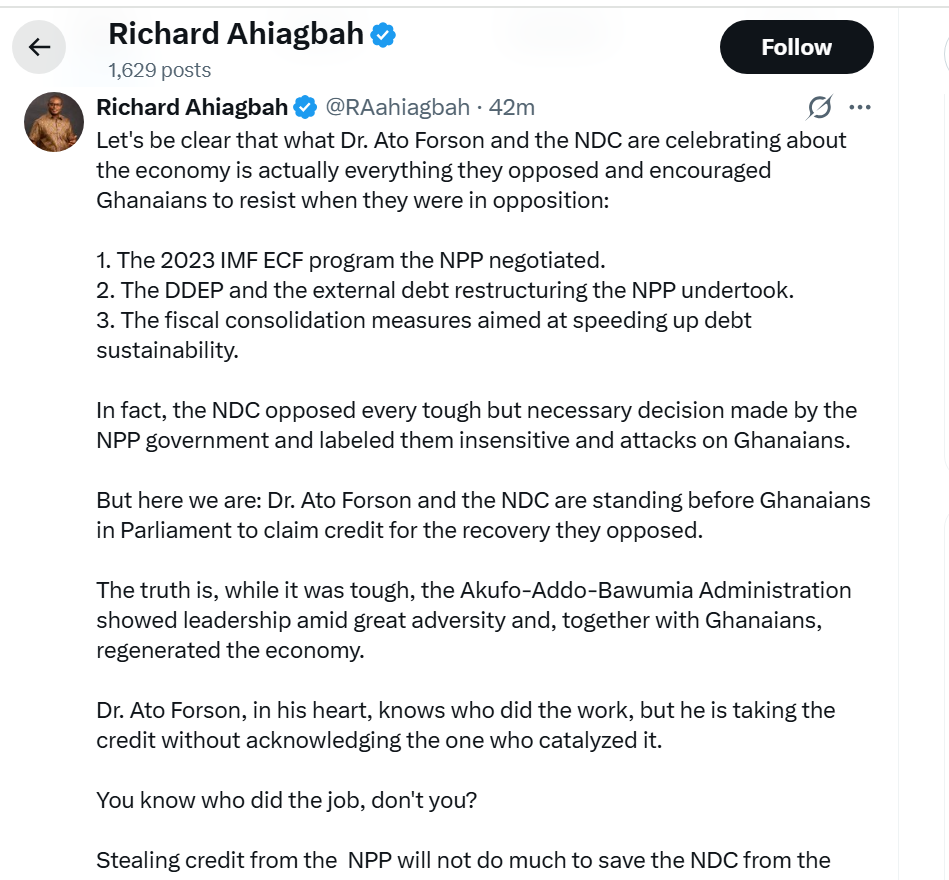
A post on his X page said that “Let’s be clear that what Dr. Ato Forson and the NDC are celebrating about the economy is actually everything they opposed and encouraged Ghanaians to resist when they were in opposition:
1. The 2023 IMF ECF program the NPP negotiated.
2. The DDEP and the external debt restructuring the NPP undertook.
3. The fiscal consolidation measures aimed at speeding up debt sustainability.
He added “In fact, the NDC opposed every tough but necessary decision made by the NPP government and labeled them insensitive and attacks on Ghanaians. But here we are: Dr. Ato Forson and the NDC are standing before Ghanaians in Parliament to claim credit for the recovery they opposed. The truth is, while it was tough, the Akufo-Addo-Bawumia Administration showed leadership amid great adversity and, together with Ghanaians, regenerated the economy.
“Dr. Ato Forson, in his heart, knows who did the work, but he is taking the credit without acknowledging the one who catalyzed it. You know who did the job, don’t you? Stealing credit from the NPP will not do much to save the NDC from the imminent defeat in 2029.”
His comments come after Dr Cassiel Ato Forson declared that the country’s economy has moved “from the Intensive Care Unit (ICU) to the Wellness Centre”.
According to him, Ghana has now shifted from crisis-driven economic management to sustained macroeconomic recovery.
Presenting an update to Parliament on Thursday, May 28, on progress in restoring macroeconomic stability and debt sustainability ahead of schedule, Dr Forson told lawmakers that Ghana is no longer a country seeking financial rescue from external creditors, but is now positioned as a credible reform partner capable of managing its own economic trajectory.
“For Ghana, this marks an important shift from seeking financial bailout to engaging as a credible reform partner while continuing to benefit from policy discipline, external validation and strengthened investor confidence,” he said.
The Minister confirmed that Ghana has successfully completed the final review of its current IMF-supported Extended Credit Facility (ECF) programme, pending formal approval by the IMF Executive Board. With that milestone reached, the country will now transition to a Policy Coordination Instrument (PCI), a non-financing arrangement that focuses on reforms, policy monitoring, and technical guidance rather than the disbursement of financial support.
The shift is being presented by government as a fundamental change in Ghana’s relationship with the IMF, from dependency to partnership.
“We have evolved from the position of supplicant to one of a partner with the International Monetary Fund,” Dr Forson told Parliament.
He also quoted President John Dramani Mahama directly on the significance of the transition: “It is my hope that this will be the very last time we ever go for an IMF bailout programme. I repeat, no further IMF financial bailout is currently required in the foreseeable future.”
At the centre of the government’s post-ECF strategy is the new PCI framework, which Dr Forson says will serve as a credibility anchor for Ghana’s economic management going forward — reassuring investors and credit rating agencies of the government’s continued policy discipline.
“The PCI will enable us to continue leveraging the IMF’s regular policy assessment and expertise as a signal to investors, thereby certifying the credibility of our stewardship and further strengthening our credit rating,” he stated.
The IMF, for its part, confirmed that its ongoing engagement with Ghana has combined the 2026 Article IV consultation, the final ECF review, and negotiations on a 36-month non-financing PCI, with emphasis on maintaining a credible fiscal path, advancing structural reforms, and strengthening economic resilience.
The Fund noted that improvements in Ghana’s debt trajectory have created some fiscal space to support development priorities, though it cautioned that this space depends on the effective implementation of ambitious public financial management reforms and measures to reduce risks linked to contingent liabilities.
Dr Forson stressed that the gains recorded are the product of strict fiscal discipline and coordinated policy action that have helped stabilise key macroeconomic indicators — including inflation, currency performance, debt restructuring, and revenue mobilisation.
Source:3news.com